
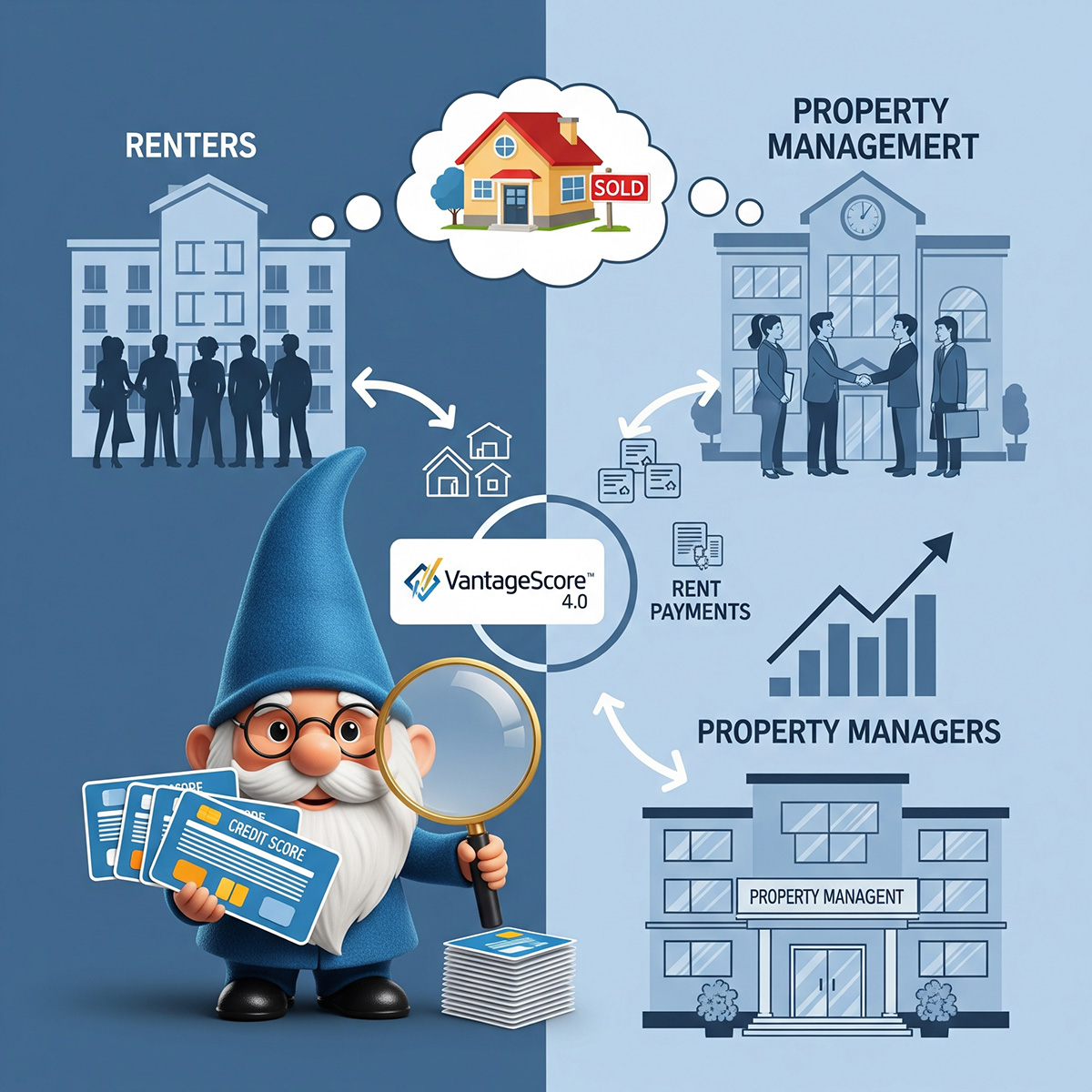
VantageScore 4.0 and the New Era of Rent Reporting: What Property Managers Need to Know. The mortgage lending landscape just experienced its most significant transformation in decades, and property managers are uniquely positioned to help their tenants capitalize on this historic change. On July 8, 2025, the Federal Housing Finance Agency (FHFA) made a groundbreaking announcement that will reshape how millions of Americans access homeownership—and rent reporting is at the center of this revolution.
The Game-Changing FHFA Decision
The FHFA announced that lenders can now use VantageScore 4.0 or Classic FICO for mortgages sold to Fannie Mae and Freddie Mac, which represent the majority of mortgages in the United States. This marks the end of a decades-long monopoly on credit scoring in the mortgage market and opens extraordinary opportunities for renters who have been building strong payment histories that traditional credit models simply ignored.
For the first time in mortgage lending history, on-time rental payments can directly influence mortgage qualification through VantageScore 4.0’s innovative approach to credit scoring.
Why This Matters for Your Tenants (and Your Bottom Line)
Here’s the reality: only about 13% of renters currently have positive rental information in their credit reports. This means 87% of renters are building credit histories that don’t reflect one of their most consistent and substantial financial obligations – rent. For many Americans, rent is their single largest monthly expense, yet it has historically been invisible to mortgage lenders evaluating creditworthiness.
VantageScore 4.0 changes everything by incorporating alternative data sources including rent, utility, and telecommunications payments into credit scores. The model scores 33 million more people than traditional models, bringing millions of previously “credit invisible” consumers into the financial mainstream.
According to comprehensive analysis involving over 600,000 renters, adding verified on-time rental payment history to VantageScore 4.0 improved predictive performance by 11%. More importantly for your tenants, renters who achieved a VantageScore 4.0 of 620 or above by including positive rental data demonstrated similar future payment patterns to consumers who achieved that score without rental data – proving that rent reporting doesn’t just inflate scores, it reveals true creditworthiness.
The Numbers That Matter
The market opportunity is staggering. VantageScore analysis projects up to $1 trillion in potential high-quality mortgage loans could result from this credit score competition. An estimated five million Americans—including veterans, prospective buyers in rural communities, and responsible renters who simply lacked traditional credit activity—are expected to benefit from FHFA’s implementation.
For property managers, this creates a powerful value proposition: you’re not just providing housing, you’re providing a pathway to homeownership. And for many tenants facing today’s challenging housing market where 47% of renters say they can’t afford to buy a home, this pathway is more valuable than ever.
How Property Managers Can Leverage This Trend
The timing couldn’t be better. With the rental market reaching a Rental Competitiveness Index of 75.2 in 2025 and occupancy rates holding steady at 93.3% nationwide, tenant retention has never been more critical. Offering rent reporting as part of your property management services provides several strategic advantages:
Enhanced Tenant Loyalty: When tenants see their credit scores improving month after month because you’re reporting their rent payments, they view you as a partner in their financial success rather than just a landlord. This emotional connection translates into longer lease terms and higher renewal rates.
Reduced Delinquency: Tenants who know their rent payments are being reported to credit bureaus treat rent with the same seriousness as a mortgage payment. Industry data consistently shows that reported rent payments result in significantly improved on-time payment rates, typically in the 79-80% range.
Competitive Differentiation: In markets where each vacant apartment attracts an average of nine interested renters, offering credit-building rent reporting sets your properties apart. For prospective tenants comparing similar units at similar prices, knowing their rent will build credit toward future homeownership can be the deciding factor.
Attracting Quality Tenants: Millennials and Gen Z renters—who represent 18% and 16% of the rent reporting market respectively—actively seek properties that offer financial wellness benefits. These demographics value rent reporting alongside other modern amenities like smart home features and digital payment systems.
The Resident Benefit Package Evolution
Forward-thinking property management companies are incorporating rent reporting into comprehensive resident benefit packages. These programs typically include credit reporting services, financial education resources, rewards programs, and various tenant perks. The cost of implementing these programs is often minimal compared to the value they generate through improved collections, reduced turnover, and enhanced tenant satisfaction.
With the median rent now at $1,373 nationally and renters spending up to 29.9% of their income on housing, every dollar matters. When tenants see tangible benefits from their rent payments beyond just keeping a roof over their heads, the perceived value of their housing costs increases dramatically.
Understanding the VantageScore 4.0 Advantage
What makes VantageScore 4.0 particularly powerful for renters is its inclusive approach to credit data. Traditional FICO models often penalized consumers for having no recent credit activity—a particular challenge for military service members, recent retirees, or individuals who responsibly avoided credit cards. VantageScore 4.0 eliminates this requirement, focusing instead on demonstrated payment behavior including rent.
Bank of America’s independent research identified VantageScore 4.0 as the most predictive credit score for mortgages when incorporating alternative data sources. This validation from a major financial institution reinforces the credibility and staying power of rent reporting in mortgage qualification.
State-Level Momentum Building
The FHFA decision builds on growing state-level recognition of rent reporting’s importance. California has implemented rent reporting mandates, while Colorado requires property managers to offer rent reporting to tenants. These state-level initiatives signal a broader trend toward making rent reporting standard practice rather than optional enhancement.
Property managers operating across multiple states should view this as an opportunity to standardize best practices across their portfolios, staying ahead of potential regulatory requirements while delivering value to tenants.
Implementation Considerations
Starting a rent reporting program doesn’t require complex system overhauls. Credit Gnomes specializes in seamless integration with property management software, automating the reporting process so it requires minimal ongoing effort from your team. The key considerations include:
Data Accuracy: Credit reporting falls under Fair Credit Reporting Act (FCRA) regulations, requiring accuracy and proper dispute resolution procedures. Working with experienced partners ensures compliance while protecting your business from potential liability.
Tenant Communication: Clearly communicating the benefits of rent reporting helps tenants understand why you’re collecting and reporting their payment data. This transparency builds trust and positions the program as a tenant benefit rather than additional monitoring.
Reporting Approach: Property managers can choose between positive-only reporting (which reports only on-time payments) and full-file reporting (which includes late payments and delinquencies). Many experts, including HUD, recommend positive-only approaches that reward good behavior while avoiding potentially harmful negative reporting for tenants working to rebuild credit.
The Future of Rent in Credit Markets
The FHFA decision represents just the beginning. As VantageScore 4.0 adoption accelerates throughout 2026 and beyond, expect to see rent payment history become standard in credit evaluation across multiple industries beyond mortgages. Auto lenders, credit card issuers, and personal loan providers are increasingly recognizing the predictive value of rent payment data.
For property managers, this creates a compounding benefit. As your tenants’ improved credit scores help them qualify for better terms on auto loans, credit cards, and other financial products, their overall financial stability improves—reducing their risk of future rent delinquency and creating a virtuous cycle of financial health.
Taking Action Now
The window of opportunity is wide open. While only 13% of renters currently benefit from rent reporting, property managers who implement comprehensive reporting programs now will capture first-mover advantages in tenant attraction and retention. As rent reporting becomes more common—potentially even standard—throughout 2026, early adopters will have already built reputations as tenant-centric operators.
Consider these action steps:
- Evaluate Your Current Technology: Does your property management software support rent reporting, or can it integrate with specialized reporting platforms?
- Review Your Resident Benefit Strategy: How does rent reporting fit within your broader approach to tenant satisfaction and retention?
- Calculate the ROI: Model the financial impact of reduced turnover, improved collection rates, and potentially higher rent premiums for properties offering credit-building programs.
- Communicate Proactively: Let current and prospective tenants know you’re committed to helping them build credit and work toward homeownership.
- Partner with Experts: Work with experienced rent reporting providers who understand FCRA compliance, integrate seamlessly with your systems, and provide ongoing support.
The Credit Gnomes Advantage
At Credit Gnomes, we’ve been pioneering rent reporting solutions for the property management industry, helping thousands of renters build credit while supporting property managers in improving their operational performance. Our platform integrates with major property management systems, ensures FCRA compliance, and provides dedicated support to both property managers and residents.
We understand that every property management company has unique needs based on their portfolio size, property types, and tenant demographics. That’s why we offer flexible reporting options, comprehensive resident benefit consulting, and scalable solutions that grow with your business.
Conclusion: A Historic Opportunity
The FHFA’s approval of VantageScore 4.0 for mortgage underwriting represents a once-in-a-generation shift in how creditworthiness is evaluated. For property managers, this isn’t just about helping individual tenants improve their credit scores—though that alone is valuable. It’s about positioning your properties and your company at the forefront of a fundamental change in the rental housing industry.
Tenants increasingly expect their housing providers to be partners in their financial journey, not just collectors of monthly payments. Rent reporting powered by VantageScore 4.0 delivers on that expectation while generating measurable business benefits for your operation.
The question isn’t whether rent reporting will become standard in property management—recent trends and regulatory developments suggest it’s inevitable. The question is whether you’ll lead this transition or follow it.
Ready to explore how rent reporting can benefit your properties and residents? Contact Credit Gnomes today for a free consultation and discover how we can help you implement a seamless, compliant rent reporting program that drives results for your business and your tenants.
About Credit Gnomes: Credit Gnomes specializes in credit reporting services for the property management industry, serving residential, commercial, HOA, and mixed-use properties across all 50 states. Our mission is to help property managers improve collections while empowering residents to build credit and achieve financial stability.